A familiar problem sits in a lot of PMM and CI inboxes right now. A rank alert comes in saying a competitor moved up, down, or suddenly appeared for a key keyword. The problem is not seeing the alert. The problem is deciding whether it means anything.
Many teams do not need more rank notifications. They need a rank tracking api setup that produces evidence they can defend in a product review, a sales brief, or a leadership update. That is harder than it looks because search results move for many reasons, and noisy tools often blur the line between a genuine competitor move and normal SERP churn.
Used properly, a rank tracking api is not just an SEO input. It is a structured source for a deterministic competitive intelligence pipeline. The difference matters. Raw rank numbers create activity. Verified signals create decisions.
Table of Contents
- Why Most Rank Tracking Creates Noise Not Intelligence
- What Is a Rank Tracking API
- From Raw Data to Verified Signals
- Essential API Features for CI Workflows
- Integrating a Rank Tracking API Securely
- Real-World Use Cases for CI Operators
- An Evaluation Checklist for Rank Tracking APIs
Why Most Rank Tracking Creates Noise Not Intelligence
The default rank tracking workflow is flawed for CI work. It watches lots of keywords, ships lots of alerts, and leaves a human to decide what is real.
That sounds workable until the first stakeholder asks a basic question. Did the competitor make a move, or did Google reshuffle the page for a day? Many tools cannot answer because they store the alert, not the proof chain behind it.
A rank change by itself is weak evidence. It becomes useful only when you can inspect the surrounding facts: location, device, ranking URL, SERP features, timing, and whether the movement persisted across pulls. Without that, teams end up briefing from unstable inputs.
The common failure mode
A PMM sees that a rival rose for a commercial term. Sales asks whether to update talk tracks. Product asks whether a feature page changed. Leadership asks whether this is the start of a category push.
If all you have is “position moved”, you cannot answer any of those questions with confidence.
What works better
A reliable setup treats rank data as one public movement input inside a broader evidence chain. The sequence is simple:
- Collect structured SERP data
- Compare it against history
- Suppress weak changes
- Promote only validated movements
- Add interpretation after verification
That trust boundary matters. Detection should be deterministic. Interpretation can come later. That is the same principle behind why competitive intelligence tools should not use AI for signal detection in 2026.
A rank alert is not intelligence. A rank alert with a verified diff, SERP context, and a reviewable timestamp is much closer.
This is why the best rank tracking api setups for CI often feel quieter than broad SEO dashboards. They produce fewer alerts, but the alerts survive scrutiny.
What Is a Rank Tracking API
A rank tracking api is a programmatic way to request search ranking data and receive it in a structured format, usually JSON and sometimes CSV. Instead of opening a browser, searching manually, and copying positions into a spreadsheet, your system sends a request and gets machine-readable SERP data back.
The easiest way to think about it is this: a web interface is like walking into a library and browsing shelves yourself. An API is like asking the librarian for one exact book, edition, and location reference, then getting it handed back in a format your system can store and compare.
What goes into the request
Most providers ask for a familiar set of inputs:
- Keyword or query such as a category term, competitor comparison term, or branded phrase
- Location such as UK, city, or postcode-level target where supported
- Device type such as desktop or mobile
- Search engine usually Google for CI use cases
- Authentication through an API key
Some APIs also let you specify parameters that sharpen local accuracy. In practical terms, that matters when your competitor wins in London but not nationally, or gains visibility in Manchester before anyone in the wider team notices.
What comes back in the response
A useful response typically includes:
- Current rank position
- Ranking URL
- Page title and snippet
- SERP features present on the page
- Timestamp
- Sometimes related metadata such as deduplicated results or full page ranges
For CI operators, the ranking URL is often more valuable than the rank number. It tells you which asset is winning. A move from a homepage to a feature page can reveal packaging or positioning intent even before the website nav changes.
What an API does not do on its own
The API is the feed, not the finished intelligence system.
It will not decide whether a move is important to product marketing. It will not know if a new page supports a launch, a pricing reposition, or a local campaign. It will not automatically separate one-day volatility from an actual competitive move.
That is where workflow design matters.
Good API data gives you inspectable facts. Good CI workflow decides which facts deserve attention.
Providers such as DataForSEO, GeoRanker, SerpAPI, and SearchApi.io solve the collection layer in different ways. The right choice depends less on feature marketing and more on whether the output supports deterministic review, historical comparison, and operator-grade filtering.
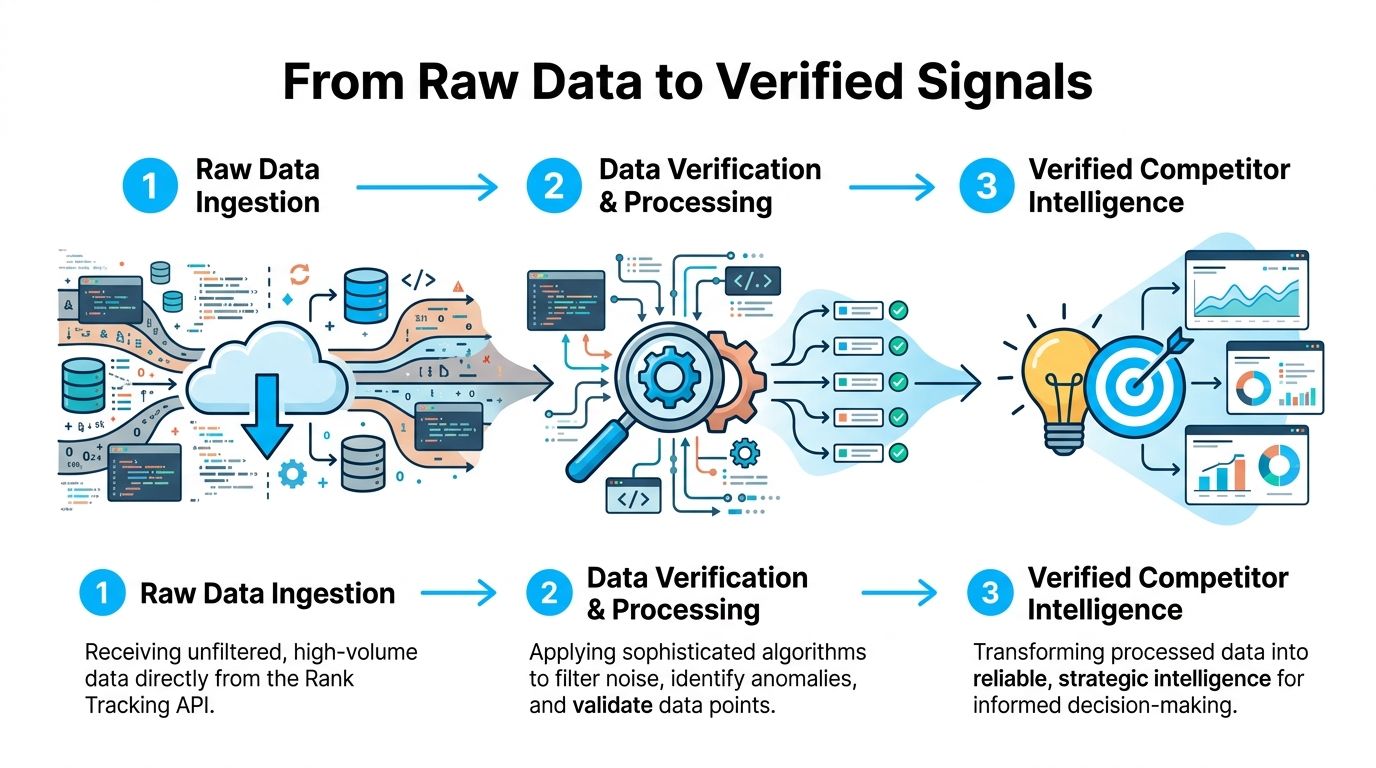
From Raw Data to Verified Signals
Many teams overvalue collection and undervalue validation. Collection is straightforward. Verification is where the system either earns trust or becomes another noisy feed.
In the UK SEO market, rank tracking APIs have become essential, with providers like DataForSEO processing a significant volume of UK keyword ranking tasks monthly. For competitive intelligence, that scale enables automated diffing that is 40-60% faster than manual tracking, which makes deterministic review practical rather than theoretical, according to Link-Assistant’s overview of rank tracking APIs.
Capture the right inputs
Start with a defined rival set and a defined keyword set. That sounds obvious, but many systems fail here by tracking too broadly.
For CI, the best keyword groups are usually tied to decisions:
- Commercial comparison terms
- Core category phrases
- Feature or use-case phrases
- Local market terms where competitors sell differently
- Brand-plus-problem searches that reveal messaging contests
Each pull should store more than position. Save the ranking URL, title, snippet, location, device, timestamp, and visible SERP features. If the provider offers JSON or CSV, preserve the raw payload as an audit layer.
Diff first and interpret later
Once you have historical pulls, compare the latest result against the prior state. This is deterministic diffing.
The most useful diffs are not always dramatic rank jumps. Watch for:
- A new URL entering the visible range
- A URL swap for the same keyword
- Title or snippet changes on the ranking page
- SERP feature changes around the result
- Movement concentrated in one city or region
At this point, many teams should pause and avoid premature narratives. A competitor ranking page change could indicate a real GTM move, or it could reflect Google preferring a different page template.
That is why interpretation should happen only after the movement is verified. The underlying logic is similar to the process described in how Metrivant detects competitor changes with an 8-stage detection pipeline.
Gate signals before they reach people
Confidence gating is what turns a feed into a working CI system.
Some practical rules are simple:
- Ignore tiny fluctuations that do not persist.
- Promote movements only when the change exceeds your threshold and carries context.
- Require confirmation on a repeat pull before briefing a stakeholder.
- Attach evidence so anyone reviewing the signal can inspect what changed.
A candidate signal becomes stronger when several facts line up. For example, a rival gains visibility for a product keyword in one UK city, the ranking URL is a new solution page, and the SERP now includes a feature format that was absent before. That is not just “rank changed”. That is public competitor movement with an evidence chain.
The cleanest workflow is source, diff, verify, interpret, act.
The result is a smaller stream of signals, but those signals are easier to trust, easier to reuse, and easier to defend in front of sales, product, and leadership.
Essential API Features for CI Workflows
A generic SEO feature list is not enough for competitive intelligence. You need API capabilities that support verification, not just collection.
Location precision matters more than headline coverage
If your provider cannot reflect the market where the buyer searches, your alerts are already suspect.
For precise competitive intelligence, APIs must support Google-encoded location targeting via the uule parameter, which can cause a 15-25% variance in keyword positions in hyper-local UK markets like London. Combined with the ability to fetch up to 100 positions and deduplicate results, this can reduce processing overhead by up to 40% in CI pipelines, as documented in SearchApi.io’s Google rank tracking API documentation.
That has a direct workflow implication. If a team tracks only “UK” as the location, it may miss a rival building strength city by city.
What to check
- Can you target by city or postcode
- Can you set location explicitly rather than relying on broad country defaults
- Can you pull enough results depth to spot new entrants before they reach page one
SERP context matters as much as rank position
A rank shift without page context is incomplete. Full SERP output matters because the cause of movement often sits around the result, not just inside it.
For CI work, useful context includes:
- Local pack presence
- Featured snippets
- Video or image features
- Questions and other result modules
- Ranking URL and page title changes
That context helps you separate a competitor content change from a layout change in the results page itself. It also makes internal briefings sharper. “They moved from fifth to third” is weak. “They now rank with a product page and the query shows a video feature beside it” is reviewable.
If the API cannot tell you what else happened on the SERP, it cannot fully explain why the ranking moved.
Reliability and output structure decide operator usability
The API also needs to behave like infrastructure.
A few features matter more than first apparent:
| Feature | Why it matters for CI |
|---|---|
| Stable output format | Makes diffing reliable and reduces parsing errors |
| Historical access or easy storage | Lets you compare states over time rather than reacting to single snapshots |
| Clear uptime commitment | Prevents blind spots in scheduled monitoring |
| Device support | Helps confirm whether a move is local, mobile-led, or broader |
DataForSEO’s documented support for postcode-level targeting, JSON/CSV output, and a 99.9% uptime guarantee makes the point clearly in a UK setting, especially when agencies need repeatable monitoring across many local markets in one system. The practical workflow question is not “does this API have lots of features?” It is “can this API help me verify a public competitor move without manual reconstruction?”
The broader workflow discipline matters too. This is the same reason teams need structured operating rules, not just feeds, when building competitive intelligence workflows that work effectively.
Integrating a Rank Tracking API Securely
A rank tracking api should be treated like production infrastructure, not a side script someone wrote for a dashboard experiment.
Treat the API like production infrastructure
Start with the basics:
- Store API keys securely and rotate them on a schedule your security team can support.
- Respect rate limits so scheduled pulls remain stable.
- Log failed calls and retries because gaps in collection can create false narratives.
- Separate raw payload storage from interpreted outputs so analysts can audit what happened.
This is not bureaucracy. It protects the trustworthiness of the output. If the collection layer is inconsistent, your downstream diffs become unreliable.
A second operational rule is to keep your transformation logic explicit. If you suppress movement under a certain threshold, write that rule down. If you require confirmation pulls before promotion, document that too. CI systems become fragile when filtering logic lives only in one analyst’s memory.
Check retention and privacy before scaling collection
Privacy and retention are often neglected because SERP data feels public. The compliance risk is usually not the fact that you checked rankings. It is how your provider stores request metadata, geodata, logs, and historical records.
As of 2026, UK GDPR compliance is a critical and often overlooked part of API selection. 72% of UK marketers report audit fears, and average fines for SEO firms reached £1.2M in 2025, according to Marketing Arsenal’s discussion of rank tracking APIs and compliance issues. The same source notes that a compliant deterministic pipeline can cut false positives by over 50% compared with noisy scrapers.
That should change how CI teams evaluate providers.
Ask directly:
- Where is request data stored
- How long are logs retained
- Can retention be limited
- Is there a clear policy for geolocation metadata
- What audit trail is available if legal or security reviews the setup
The safest pipeline is not the one that collects the most. It is the one that collects what it needs, retains it intentionally, and can explain its own handling.
For founder-led and growth-stage teams, this matters even more. Informal collection often grows faster than governance. By the time legal asks questions, the architecture is already messy.
Real-World Use Cases for CI Operators
A rank tracking api becomes valuable when it supports decisions outside the SEO team. The most useful signals answer three questions: what changed, why it matters, and how to review it.
A short walkthrough helps more than another abstract framework.
A rival starts winning in a local market
A practical use case involves tracking a rival domain through a request like /rankings with domain=competitor.co.uk and keywords=['crm software london']. In one documented example, the API reveals the rival gained #2 position in Birmingham, supporting a validated narrative like “Rival X gained #2 in Birmingham for 'saas analytics' due to a new video carousel, assess pricing parity”. That workflow yields 85% fewer false positives than broad scrapers, based on GeoRanker’s rank tracker API example.
Localised gains often show a go-to-market move before the wider organisation spots it, which is significant. A CI operator can review the ranking URL, inspect the page, check whether the pricing or proof changed, and brief regional sales with evidence rather than speculation.
Here is the video referenced for this workflow context:
A messaging shift appears in the SERP
One of the most useful non-obvious signals is a title or snippet change on a page already ranking for a bottom-of-funnel query.
That change can reveal:
- A repositioned use case
- A new proof point
- A stronger commercial angle
- A shift from broad category language to buyer-specific language
The review process is simple. Compare the current result with the historical version, open the page, and check whether the visible on-page messaging matches the SERP rewrite. If it does, product marketing now has a public signal tied to buyer-facing language.
A new page suggests a launch before the press release
A fresh URL entering the visible range for a tracked product term is often more important than a mature page moving a few positions.
For example, if a competitor’s domain starts ranking with a previously unseen solution page, that can indicate:
- A feature launch
- A packaging change
- A new vertical play
- A regional expansion page
The review step often provides teams with an advantage. Open the page, capture the proof, check related site areas, and route the signal to the right stakeholder. Sales may need new objection handling. Product may need parity review. Founders may want to know whether the rival is testing a new segment.
For revenue teams, this style of evidence is particularly useful in field enablement. It fits naturally with competitive intelligence for sales teams trying to win more competitive deals in 2026.
An Evaluation Checklist for Rank Tracking APIs
The fastest way to choose the wrong provider is to buy on feature count alone. CI teams should buy on evidence quality.
When evaluating APIs, accuracy is paramount. Providers using local IPs from UK data centres can achieve 97% accuracy, outperform global proxies by 20-30%, and avoid personalisation bias. With 46% of UK searches being local, that precision is essential for CI that can survive scrutiny, according to Keyword.com’s guidance on choosing a rank tracker.
Use this checklist before you commit.
Core evaluation points
Accuracy model
Ask whether the provider uses UK-local IPs and how it handles personalisation bias.Location granularity
Check whether targeting works at city or postcode level, not just country level.SERP completeness
Confirm you get ranking URL, page data, and surrounding SERP features, not just a position number.Historical usability
Make sure the output is easy to store and compare over time in your own system.Reliability
Look for a documented uptime commitment and stable response structure.Compliance posture
Review retention, logging, and geodata handling before procurement signs off.Operator fit
Test whether an analyst can inspect a movement quickly without rebuilding context by hand.
The right API is not the one with the loudest dashboard. It is the one that lets your team prove what changed.
If you are comparing CI options more broadly, this same discipline applies when reviewing the best competitive intelligence tools in 2026 evaluated by signal quality rather than feature count.
If your team wants fewer alerts and stronger proof, Metrivant is built for that exact operating model. It turns public competitor movement into verified competitor intelligence through deterministic detection, confidence-gated signals, and an inspectable evidence chain, so PMM, CI, strategy, and founder-led teams can brief stakeholders with more confidence and less noise.